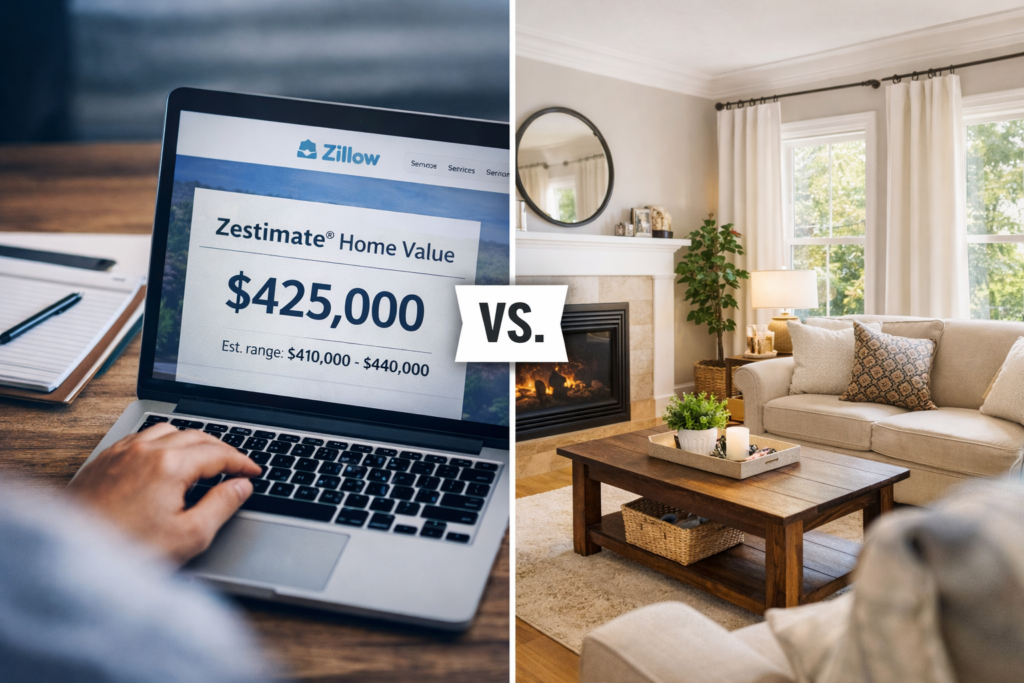
When someone begins thinking about selling their home, the first place they often turn is Zillow. Before calling an agent, before making updates, and sometimes before even telling their spouse, they quietly search their address online. For many homeowners, Zillow has become the go-to source for checking home value because it feels immediate, objective, and data driven. Within seconds, it delivers a number that can feel reassuring or alarming. Since the estimate updates automatically, it creates a sense of precision and authority. However, your home value is not what Zillow says, and the difference can be significant. While automated estimates appear reliable, they rely on formulas that cannot interpret nuance, condition, competition, or market timing. If you are considering selling in Fayette County or Coweta County, relying solely on that number could shape expectations in ways that influence pricing, strategy, and ultimately your equity.
First, Zillow uses public data and broad algorithms. Although it analyzes square footage, bedrooms, bathrooms, and prior sales, it cannot walk through your home. Therefore, renovations, layout improvements, and overall condition are often misrepresented. A beautifully updated kitchen may not increase the estimate properly. Meanwhile, outdated interiors may not reduce it enough.
In many ways, Zillow measures the science of pricing, but not the art. It studies numbers, trends, and recorded sales. However, it does not evaluate aesthetics, design flow, natural light, or emotional impact. Buyers respond to how a home feels, not just how it calculates. Because presentation influences perception, the art side of home value matters just as much as the data.
Additionally, algorithms struggle with micro market shifts. Two homes on the same street can command very different prices. Because buyer demand fluctuates by price range, timing influences home value significantly. Historical averages alone cannot reflect current competition.
Moreover, Zillow does not fully evaluate active listings. Buyers compare your property to homes available today, not homes that sold months ago. If competing listings show stronger staging or cleaner presentation, perceived value shifts immediately. An automated system cannot measure buyer urgency or emotional connection.
Interestingly, many homeowners notice something else. If you monitor a Zillow estimate closely, it often adjusts once a property is listed. In many cases, the value updates quickly to align more closely with the list price. That shift does not mean the algorithm suddenly uncovered new information. Instead, it reflects how automated systems recalibrate around listing data input.
Because of this, relying solely on Zillow can create false confidence. Some sellers overprice based on inflated estimates. Others undervalue their equity because the calculation feels conservative. Either mistake affects negotiating power and can influence how buyers perceive urgency. True home value requires interpretation. We examine how quickly comparable homes sell in Fayette County and Coweta County. We analyze price per square foot trends, days on market patterns, and buyer behavior within specific price tiers. Data must be understood within context.
That context becomes even more important in strong micro markets. In areas like Peachtree City, value can shift dramatically from one neighborhood to the next. School district lines, amenity access, lot location, and even street placement can influence buyer demand. Two homes with similar square footage may perform very differently based on those subtle distinctions. Automated systems often group properties broadly, yet local nuance drives real pricing. Understanding those micro differences allows pricing to be strategic rather than reactive.
Equally important, preparation influences home value. Strategic updates, fresh paint, and enhanced staging can shift buyer response dramatically. Lighting, photography, and positioning shape first impressions online. Automation simply cannot measure those human factors.
Ultimately, your home value is both science and art. It blends data, competition, timing, psychology, and presentation. Zillow provides a snapshot, yet strategic insight protects equity. Real experience bridges the gap between numbers and nuance.
Happy learning,
The Gals at Good to Be Home 🐝